Channel Feature
Eight rare maps and celestial atlas’: In conversation with The Sunderland Collection
July 2025
The Sunderland Collection, a private collection of rare antique cartography, has loaned eight atlases and maps to the Sainsbury Centre as part of A World of Water.
Our PR and media officer, Kate Wolstenholme, spoke to custodian of The Sunderland Collection, Helen Sunderland-Cohen, about the special collection.
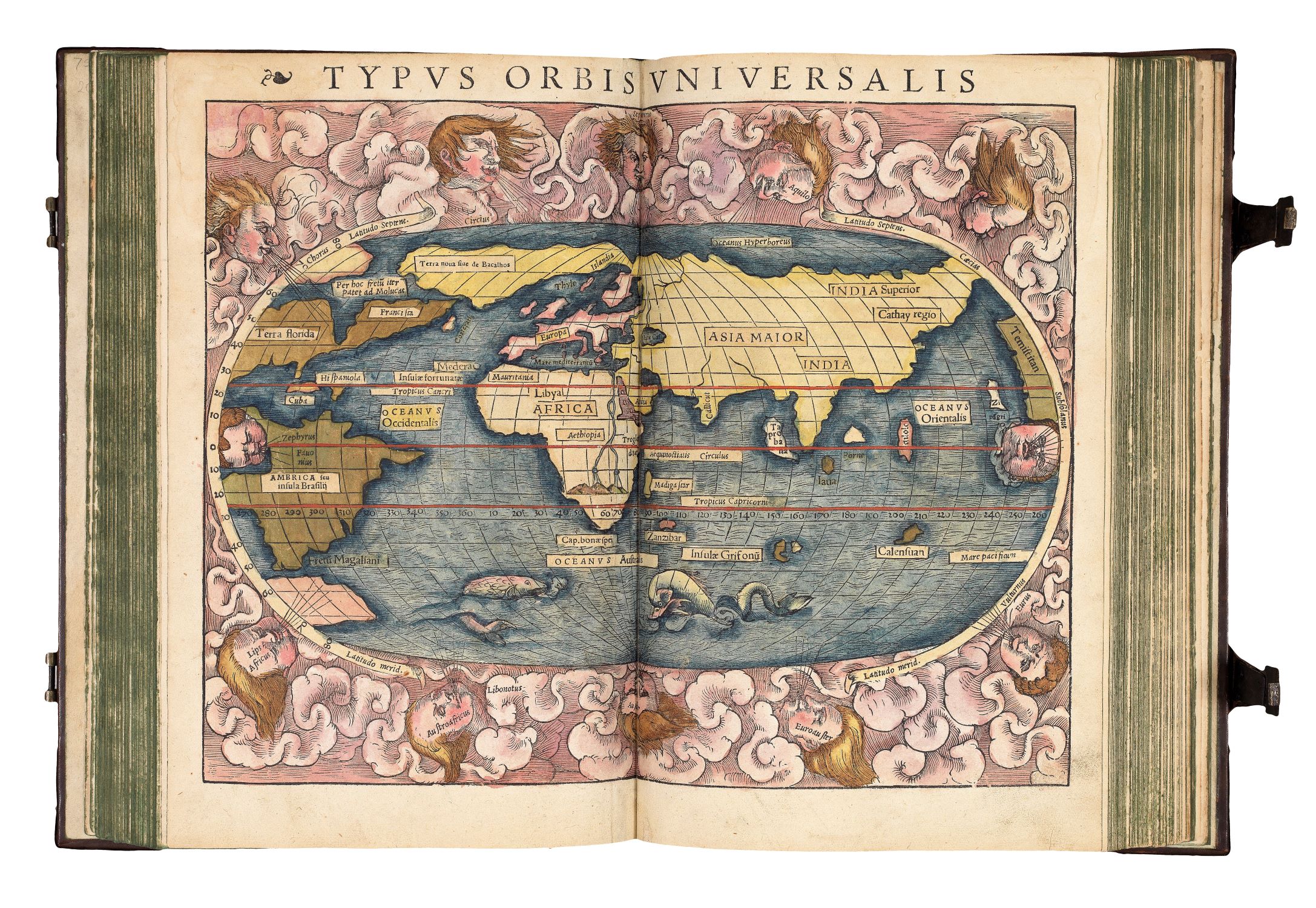
This is the first time in its 40-year history that the private collection has loaned to a public institution. Featuring world maps, celestial maps, atlases, books of knowledge and globes, the collection showcases the evolution of knowledge, as well as being a celebration of human exploration and discovery. The collection’s rare version of the Geographia (Sebastian Münster, 1540) in original colour is the oldest work to be included in the exhibition.
Our PR and media officer, Kate Wolstenholme, spoke to custodian of The Sunderland Collection, Helen Sunderland-Cohen, about the special collection.
KW: How did the Sunderland Collection begin, and what were the intentions for the collection when it was founded?
HS: It began very organically, through the personal collecting of my father, Dr Neil Sunderland. He has always loved remote travel, ideas, encounters, and thinking about the evolution of knowledge across cultures. It was not founded with the intent to be a collection per se; it evolved into one naturally. Once we realised that this had happened, we decided to open it up to the public and make is as accessible, and useful, as possible.
KW: With so many incredible detailed maps in your collection. How were the eight maps chosen for A World of Water – what was this process?
HS: I was approached by the Sainsbury Centre’s wonderful curator of art and climate change, John Kenneth Paranada. It was very much a joint exercise selecting the items, based on the themes of the exhibition.
Thinking about the seas, and humanity’s interaction with them, as well as the United Kingdom’s history with the oceans as an island nation, and Britain’s relationship with Holland, it seemed fitting to include three very famous nautical atlases: Waghenaer’s famous Mariner’s Mirror, which is a beautiful, early book of hand-coloured sea charts of the European coastlines containing both beautiful illustrations and hard data for sailors; the Goos Zeeatlas or Sea Atlas, which is from the late 17th century during the heyday of Dutch cartography; and the legendary Arcano delle Mare (Secrets of the Sea) by Robert Dudley, an Elizabethan work created for the Medici family in Florence.
We also selected the stunning celestial atlas by Cellarius from 1661 (the stars being important for navigation by sea), and Munster’s Geographia. Kircher’s book on the subterranean world was chosen for its theories on how the world’s water, weather, and subterranean fire interact. And we selected the first atlas produced in English, by John Speed, because it reflects Britain’s role as a seagoing nation and a colonial power.
Finally, we added the Drake Map by Hondius (a Dutch cartographer living in London), which shows the circumnavigation of the world by the English adventurers Drake and Cavendish – and is a beautiful piece of engraving.
KW: To have a map in A World of Water from 1540 is incredibly special. Could you talk to Sebastian Münster’s Geographia – what does it detail and who was it made for, and how? How did Münster transform mapping?
HS: Münster was a monk, teacher, and cartographer who was born in Germany and ultimately settled in Basel. He was very influential both in terms of his cartography and geographical knowledge. Munster’s masterpiece was the Cosmographia Universalis – a copy of which is also in the Sunderland Collection. The Geographia is his edition of Claudius Ptolemy’s seminal work. Münster’s edition was highly influential as it contained the latest information about the world from a European point of view, and it was the first time that an atlas contained a separate map for each continent. It also contained the first printed map of England. The maps and other illustrations in this book are beautiful.
The Geographia was made using woodblock print and then hand-coloured. The maps are very skilfully executed, and the contemporary colour is still bright.
You can see all the plates in this beautiful work here.
KW: In the Sunderland Collection’s podcast, What’s Your Map?, guests speak of the maps which inspire them. What would be your story here?
HS: It would be the John Speed atlas because that was one of the first atlases that my father collected, and therefore the first time I had ever encountered, and been able to handle, such an old object. It was a big inspiration and fascination to me as a teenager, and one of the reasons I went on to study history. There is a hand-written inscription in the front flyleaf in beautiful script, which talks about Speed. I loved the idea that someone else had owned the atlas hundreds of years ago, had turned the pages like me, and had written that text – it really brought home to me the personal, intimate journeys that old objects have been on, and the human lives that they have touched, and that have touched them.
KW: At the Sainsbury Centre, our seasons of exhibitions ask some of life’s biggest questions, such as Can the Seas Survive Us? in which A World of Water sits as part of. What would be a big question you would like to ask?
HS: Why does history repeat itself? What can we learn from the past – and why don’t we?
Full list of items on loan by The Sunderland Collection to the Sainsbury Centre:
- Geographia, Sebastian Münster, 1540
- Speculum Nauticum, Lucas Janszoon Waghenaer, 1586
- The Drake Map, Jodocus Hondius, 1589
- Del’ Arcano del Mare, Robert Dudley, 1646-47
- Harmonia Macrocosmica, Andreas Cellarius , 1660
- Mundus Subterraneous, Athanasius Kircher, 1664-65
- Theatre of the Great Empire of Britaine, John Speed, 1667
- Zee Atlas, Peter Goos, 1675
A World of Water is on display until 3 August, 2025, as part of the Can the Sea Survive Us? season.
Visit the work of The Sunderland Collection’s, Oculi Mundi. Connect with the Oculi Mundi Instagram and The Sunderland Collection Instagram.