Channel Feature
Jill Gibbon on the inner world of global arms fairs, and Seeds of Hate and Hope
February 2026
Artist Jill Gibbon talks to Digital Communications and Creative Curator, Bea Prutton on her work in our current exhibition season, Can We Stop Killing Each Other?
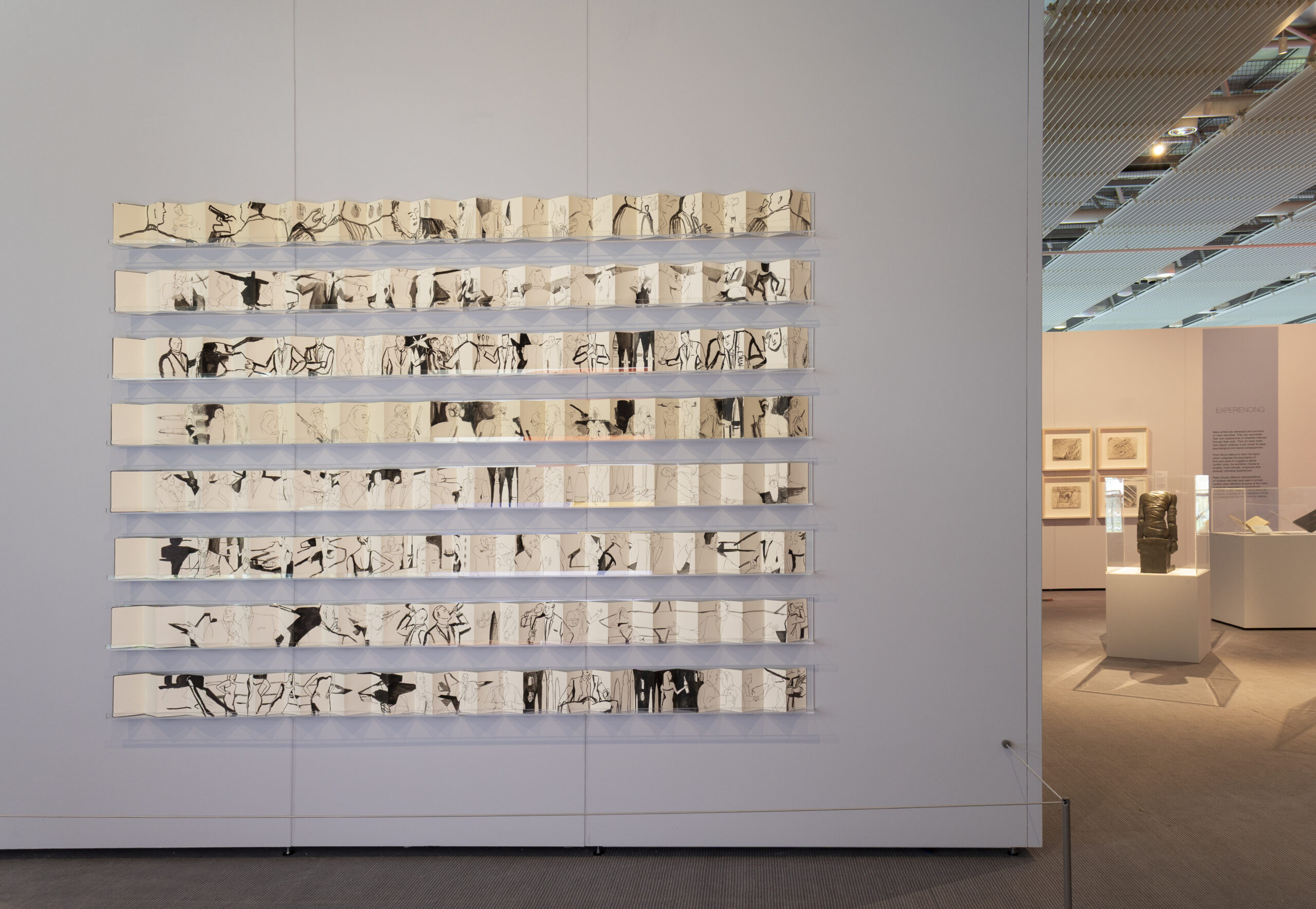
Bea Prutton: Your work delves into the clandestine inner world of the arms trade. Where did your interest in this global industry begin?
Jill Gibbon: I grew up in the Cold War when there was a continual fear of nuclear annihilation. I went to Greenham Common in my early twenties and remember looking through the fence at bunkers being prepared for US cruise missiles. When the Cold War ended, there was a sense that change was possible. There was talk of a peace dividend, diverting military production to sustainable energy and clean forms of transport. Instead, arms companies merged into multinationals, producing and selling weapons around the world. The London arms fair, DSEI (Defence Security Equipment International) was set up at around this time to offer a venue for international arms deals.
There is a long tradition of official war art, where artists are commissioned to draw in war zones. I thought it would be interesting to turn this around, to look in the other direction. So, I applied for a pass to DSEI as an ‘official war artist’. Although there was nothing official about me, it worked. For a time.
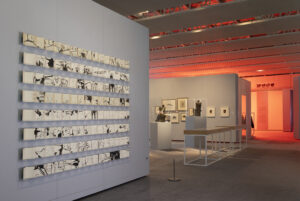
Undercover drawings of the arms trade, Jill Gibbon, From 2007, Ink on paper. Copyright courtesy of the artist. Photo by Kate Wolstenholme.
BP: Can you tell us about the moment you walked into your very first arms fair? What did that feel like? What struck you?
JG: I first visited DSEI in 2007. I still remember the shock. I imagined a reserved event with hushed meetings in sombre rooms. It was the opposite – a glitzy trade show.
Missiles branded with corporate logos are suspended from the ceiling. Bombs are illuminated on pedestals. Pistols are lined up like a fairground shooting game. Women in tight dresses lean against tanks. Mannequins pose in the latest camouflage, aiming rifles at imaginary targets. Fighter jets and helicopters are parked outside on the tarmac. Video screens show explosions, with no sign of their impact on people. In one corner, a string quartet plays Mozart and Handel on the back of a military truck. And around the merchandise, waiting staff circulate with beer, champagne, cake and pretzels. There are also complementary gifts – stress balls in the shape of bombs, toy missiles, keyrings with bullet pendants, condoms.
In addition to shock, I felt overwhelmed trying to draw this, a feeling that has not lessened over subsequent visits.
BP: Your series began in 2007. How have arms fairs changed in the last two decades, and what remains the same?
JG: The marketing changes in response to global conflicts. In 2007, the main sales slogan was the ‘war on terror’. A few years later, during the violent suppression of pro-democracy protests in the Middle East and anti-austerity protests in Europe, there was an emphasis on ‘crowd control’ to promote tear gas and equipment for security forces. The wars in Yemen and Ukraine have brought bigger fairs and more lavish hospitality. Israel’s occupation of Palestine and genocide in Gaza is evident in slogans advertising ‘combat proven’ and ‘battle tested’ missiles. And, as people flee wars and repression, arms companies offer militarised methods of border control.
Over the years, I have also watched the profile of the largest arms corporations grow. Weapons are also constantly updated and reinvented with new technologies. Autonomous Weapons are the latest thing.
What has remained the same over the past two decades is the surreal combination of missiles, suits and complementary wine.
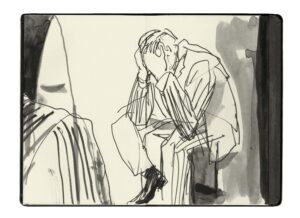
Undercover drawings of the arms trade, Jill Gibbon, From 2007, Ink on paper. Copyright courtesy of the artist.
BP: Do you have to produce your drawings discretely? If so, how do you hide them?
JG: In the early years of the project, I visited DSEI as an ‘official war artist’, so I could draw fairly openly. Then a security guard looked over my shoulder, examined the drawings, and told me to leave saying, ‘If you are an official war artist, go and draw in Iraq.’ I got into the next fair by calling myself a ‘security consultant’ and wearing a suit and fake pearls. After that, I had to disguise the process of drawing under the guise of taking notes.
I draw in concertina notebooks. They are small enough to pass as a notebook but can be opened out to work on a larger scale, or to exhibit. I use pens, adding ink washes later. I am increasingly haunted by things I have seen in the fairs, so I draw some incidents over and over again from memory afterwards.
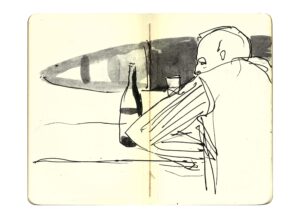
Undercover drawings of the arms trade, Jill Gibbon, From 2007, Ink on paper. Copyright courtesy of the artist.
BP: Your drawings reveal a collective sense of unease amongst attendees to these arms fairs. Despite the sheen from the facade of pinstripe suits, slick displays of weapons under bright lighting, and glasses of champagne, all set to the soundtrack of string quartets playing Mozart, there is an undeniable discomfort revealing itself in your drawings. Why do you capture this?
JG: I am glad you notice unease in the drawings, because it runs through the industry. I soon learned if I was going to stay in a fair, I had to act the part of an arms trader – nodding, smiling and gazing at the exhibits as if everything was normal, whatever I was feeling inside. Then, I realised I wasn’t the only one pretending. Everyone is taking part in a performance of respectability. The suits, handshakes and sales gestures give the impression that the arms trade is an ordinary business. But the façade regularly cracks. Expressions of despair, horror or greed break through the surface. This is accentuated by the continual heavy drinking. I once heard an arms trader say, ‘You can’t do deals in this business unless you are drunk.’ More than once, I have seen a guest slumped across a table or the floor, having overdone the hospitality.
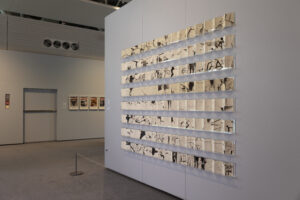
Undercover drawings of the arms trade, Jill Gibbon, From 2007, Ink on paper. Copyright courtesy of the artist. Photo by Kate Wolstenholme.
BP: Why are exhibitions like Seeds of Hate and Hope at the Sainsbury Centre important? What role does art play in contemporary conversations around the ethics of war and the commodification of weaponry?
JG: Art is double edged. It has historically been used to create an aesthetic veneer that hides war and colonialism. However, as DADA showed, art can also be used to turn the veneer inside out, and strip back the pretence. But it relies on galleries to exhibit this kind of work. So, I am really grateful to the Sainsbury Centre for showing Seeds of Hate and Hope.
BP: At the Sainsbury Centre, we believe art can help us investigate life’s biggest, most universal questions. If you could pose a question to be explored through the lens of art, what would it be?
JG: People or profits?
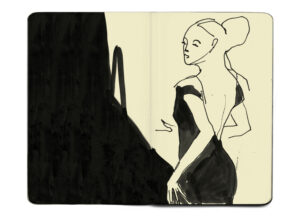
Undercover drawings of the arms trade, Jill Gibbon, From 2007, Ink on paper. Copyright courtesy of the artist.
Find out more about Seeds of Hate and Hope here.
Seeds of Hate and Hope is curated by Tafadzwa Makwabarara, Curator of Cultural Empowerment at the Sainsbury Centre and Jelena Sofronijevic, independent curator, writer and producer of the EMPIRE LINES podcast.
Our thanks go to Jill Gibbon for this interview.