Channel Feature
‘Real crises are solved by collective action’: Josh Kline on science fiction in art
May 2025
“The ice is going to melt and the seas are going to rise. It’s physics. The question we face now is how bad will we allow it to get?”
John Kenneth Paranada in conversation with Josh Kline
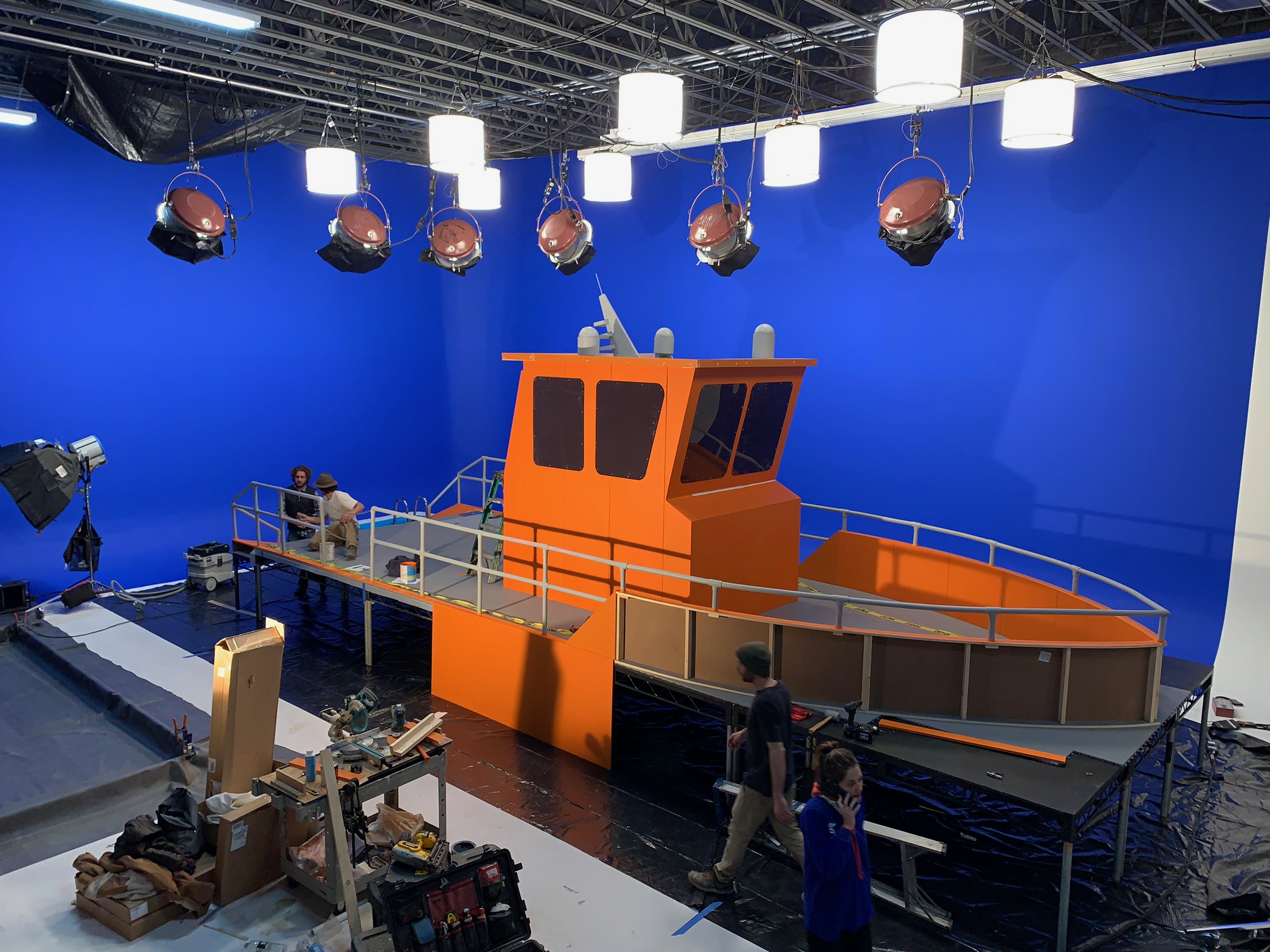
Josh Kline’s Adaptation (2022) imagines a flooded Manhattan not through the spectacle of catastrophe, but through the quiet repetition of daily survival. A multi-racial, multi-gendered crew of divers surface in what was once Midtown, rinse off the day’s labour, and drive through the city onboard a motorboat. The video piece is on display in A World of Water as part of the Can the Seas Survive Us? season.
The film unfolds in a slow rhythm and is a vision of a world reshaped by climate collapse, but held together by the steady, often invisible work of simply carrying on, and the film is as much about the now as it is about what lies ahead.
In conversation with John Kenneth Paranada, curator of art and climate change at the Sainsbury Centre, Kline reflects on speculative futures, the emotional reach of science fiction, and how resilience might look and feel in a world already underwater.
JKP: To begin, could you briefly tell us about your artistic practice and the ideas that have shaped your work over the past decade? How have these evolved in relation to the political, environmental, and technological shifts we’re currently facing?
JK: In 2014, I sketched out and began work on a cycle of science-fiction installations that would look at the political, economic, and technological issues likely to define life in the 21st Century. The cycle would be like a novel or a series of novels, with each installation acting like a chapter. The first chapter, Freedom (2015), was set in what was then the present, during the Financial Crisis and Great Recession. Each subsequent chapter would jump a couple decades further into the future.
Freedom looks at corporate social media and its impact on democracy and political speech. The second two chapters were set in the 2030s or 2040s. Unemployment (2016) imagines the end of the middle-class and a world of mass-unemployment caused by AI and automation. Civil War (2017) is about the possible political consequences of this—about explosive class division and the unravelling of America. The fourth chapter Climate Change (2019-2024) is set in a world of mass-migration and climate crisis. Adaptation is part of this larger project. I have plans for two more chapters, which are radical utopias.
I don’t have a traditional studio-based art practice. When I was starting out as an artist in the 2000s, I rented out a small studio and gave it a try, but quickly filled it up with sculpture. Now, I hash out my ideas in writing and in my imagination and then when the opportunity to make a new exhibition comes, I narrow in on the strongest ideas and try to realize them. I build groups of works as installations. When they come together, the sculptures, videos, films, images, architecture, lighting combine to tell a larger story – one you can walk around in. The way I work is more like a novelist or a filmmaker. I start with outlines and the media and materials I use follow the ideas.
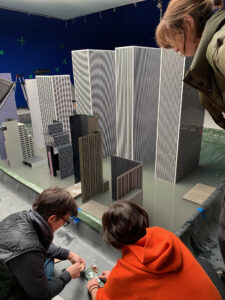
On the set of ‘Adaption’ by Josh Kline. Courtesy of the artist
JKP: In Adaptation, you show a world reshaped by climate change. Rather than dramatic disaster scenes, there’s a quiet rhythm to the way these workers move through a flooded city, doing their jobs. Why did you choose to focus on the everyday — maintenance, routine, and the mundane — as a way of showing crisis? What does this slower, more subtle approach reveal?
JK: So much science fiction is about the spectacular. About messianic superheroes flying in from outer space or Silicon Valley to save the day. This focus on supernatural salvation is really widespread in the West. It’s the same kind of thinking that leads a society to seek redemption in the arms of a demagogue. Meanwhile, real crises are solved by collective action—by the actions of thousands or millions of regular human beings.
Adaptation was always meant to be a science fiction of everyday life, but its meaning changed as I edited it and wrote and recorded new voiceovers during lockdown and quarantine in 2020 and 2021. The film became as much about the pandemic as it was about climate disaster later in the 21st Century. I started to see the pandemic—and the total disruption of normal life we all experienced during it—as a kind of preview for the even greater disruption that the climate crisis will bring in the coming decades.
Our recent experiences living in a real dystopia, could become a way to understand what’s coming emotionally, in a way that scientists and politicians find difficult. I tried to evoke the feeling of life in New York during the pandemic through the pacing and the mood of the film. The soundtrack that Galcher Lustwerk composed for Adaptation also carries something of the isolation and loneliness of those long months.
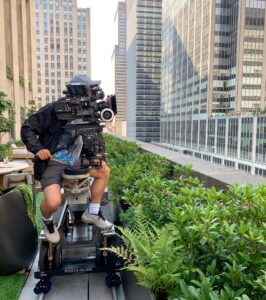
On the set of ‘Adaption’ by Josh Kline. Courtesy of the artist
JKP: Science fiction plays a key role in your work, especially in Adaptation. But you don’t use it to imagine far-off futures, your scenarios feel close, maybe even just around the corner. What draws you to science fiction as a way of telling these stories? What do you think it allows you to explore that other art forms or genres might not?
JK: Science fiction is a way of visualising possible futures. As a genre, it’s inherently about tomorrow. It asks about what kind of world we want to live in. It’s also a way of talking about the present, about the world that leads to those possible futures. There’s no other genre that looks forward in the same way – outside maybe economic forecasts or scientific research. In the same way that science fiction is a genre in film, television, and literature, it can also be a genre in art. Unlike the history of painting, whose every nook and cranny has been explored with an electron microscope, science fiction still feels wide open and full of possibilities.
JKP: This season at the Sainsbury Centre asks: Can the Seas Survive Us? It’s a shift from the usual question — can we survive climate change? In Adaptation, the city is submerged not just by water, but by the long-term impacts of fossil fuels, extraction, and political failure. Do you think your work suggests a kind of mutual adaptation — where both people and oceans are being reshaped by each other?
JK: I’m fundamentally a humanist. I never want to close off other readings or possibilities in the work, but for me Adaptation is about human beings, about people. Human beings will have to adapt to a more dangerous world with higher seas, more fires, and less arable land. Scientists tell us that radical climate change is now unavoidable. The accelerating damage over the last three decades has baked it in. The ice is going to melt and the seas are going to rise. It’s physics.
The question we face now is how bad will we allow it to get? How much suffering will we let the world’s powerful summon into being in the future as they loot tomorrow in order to be rich today. As societies, we could choose to reduce carbon emissions and relocate populations. The oceans and the animal and plant life in them don’t have the same choices. It’s hard to adapt to deliberate extermination.
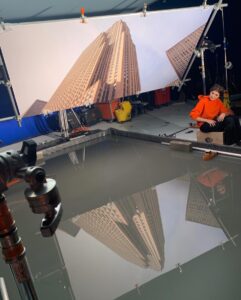
On the set of ‘Adaption’ by Josh Kline. Courtesy of the artist
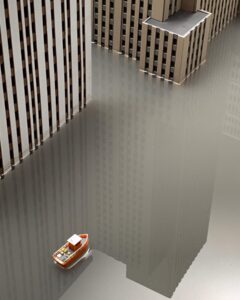
On the set of ‘Adaption’ by Josh Kline. Courtesy of the artist
JKP: The cast in Adaptation is diverse, and there’s no sense of heroism — just people working, surviving, carrying on. Since climate change hits hardest along lines of race, class, and geography, how important was it to centre those who are often overlooked — not just as victims, but as essential workers and everyday responders?
JK: I think it’s vital. In Adaptation, I wanted to focus on a crew of working people in the waterlogged ruins of America’s financial capital. During the pandemic, the characters in the unfinished film took on the additional identity of essential workers—of the people who have to risk their lives going to work when more privileged people can stay home. When disaster strikes, who is it that’s always left to clean up the mess? It’s not a superhero. It’s always working people.
Adaptation is set in New York City in the mid-to-late 21st Century. It’s not explicitly stated in the film, but I imagined that the people on the boat had been New Yorkers, and that they had to flee the city when it finally flooded out. They’re looking out from the boat on their former home. The film has a small cast, but they’re meant to mirror New York’s people. New York is one of the most diverse cities on Earth.
JKP: Looking ahead, in a world where sea levels have permanently changed the way we live, what kinds of life do you imagine continuing — or even thriving? Do you see possibilities for new forms of resilience, care, or community that could grow out of that kind of transformation?
JK: Human beings have survived unimaginable horrors. We may lose New York, London, Singapore, Shanghai, San Francisco, and all the world’s other wealthy, coastal power centres, but people will find ways to survive on the other side of what’s coming. That said, it’s easier to build when the world isn’t in ruins. Right now, the focus needs to be on changing the present in order to change the future. We need to find those new forms of resilience, compassion, and solidarity today.
Adaptation can be seen in A World of Water until 3 August.