Channel Feature
A body of work bound by water: In conversation with Julian Charrière
June 2025
“Water, for me, isn’t just a theme – it’s a way of thinking. It carries memory, dissolves boundaries, and reshapes how we perceive time and space. Whether it’s a melting glacier, an irradiated atoll, or the deep ocean, water in my work becomes a kind of collaborator.”
"Water, for me, isn’t just a theme – it’s a way of thinking"
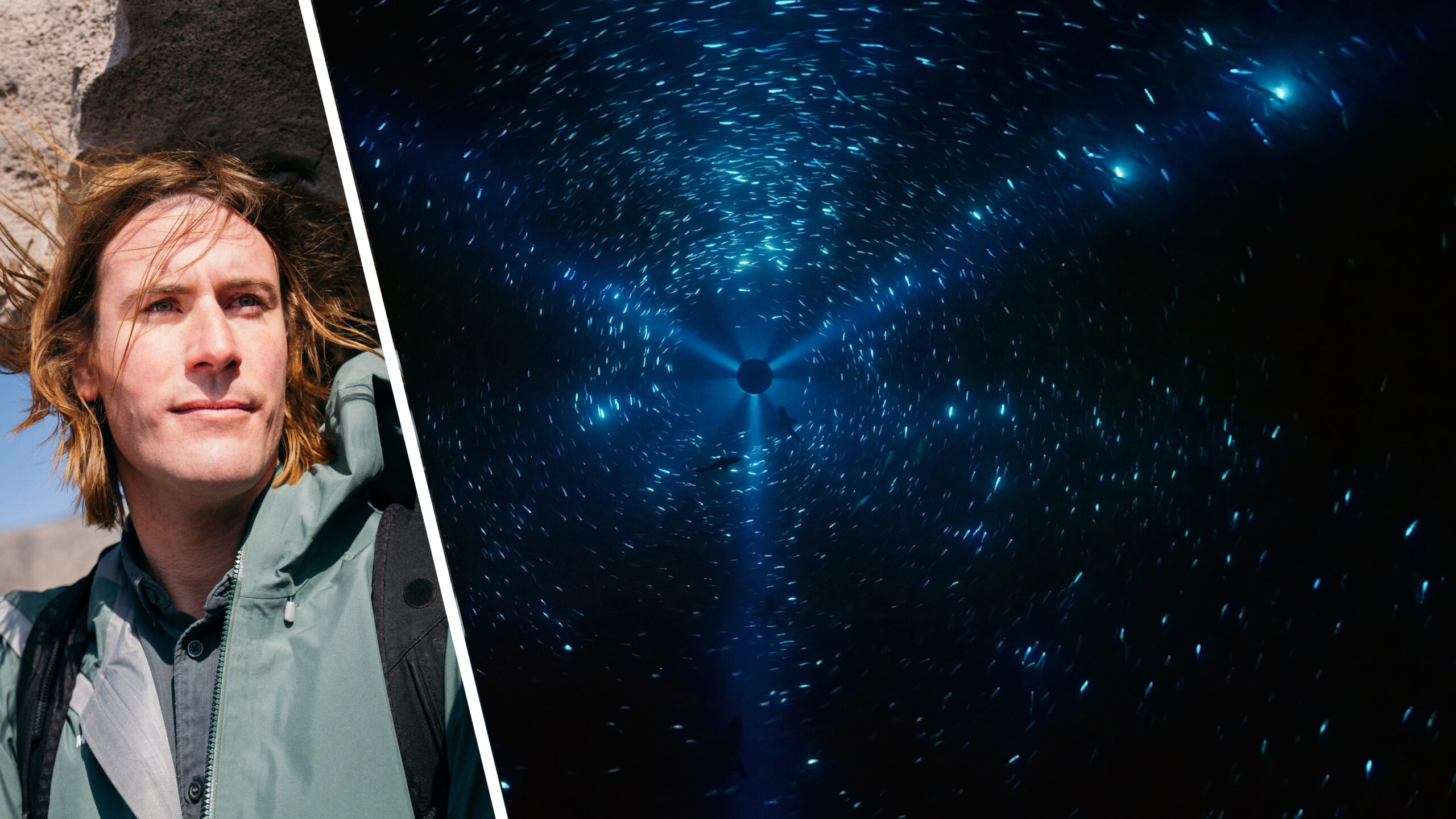
Julian Charrière is a French-Swiss artist living and working in Berlin. Charrière explores ideas of nature and its transformation over deep geological as well as human historical time. Addressing pressing matters of ecological concern, his work frequently stems from fieldwork in remote locations.
Multiple pieces of his work feature in A World of Water, on display as part of the Can the Seas Survive Us? season. In this interview with the Sainsbury Centre’s curator of art of climate change, John Kenneth Paranada, Charrière talks to how the oceans and the seas remain a focus within the artist’s work.
JKP: Many of your works cross glacial edges, expose atolls, and abyssal depths—yet they are bound by water. How do you think about water not just as a theme, but as a medium of time, transformation, and entanglement in your work?
JC: Water, for me, isn’t just a theme – it’s a way of thinking. It carries memory, dissolves boundaries, and reshapes how we perceive time and space. Whether it’s a melting glacier, an irradiated atoll, or the deep ocean, water in my work becomes a kind of collaborator. It’s not just something I look at, but something that moves through us – physically, emotionally, historically.
When you dive, you feel that directly. The usual structures – gravity, direction, even the boundary between your body and the environment – start to dissolve. You’re not moving through the ocean so much as becoming part of it. Light behaves differently, up and down lose their meaning, and suddenly you’re inside a medium that absorbs rather than reflects. That experience has profoundly shaped how I think about art and perception – how I even engage with the reality of the surface.
Across different projects, water started to act as a connector – it links distant geographies, different temporalities, and overlapping crises. Water challenges the illusion of separation and reminds us that we’re not standing outside the world – we’re already immersed in it.
Julian Charrière. Copyright the artist; photo by Roselena Ramistella
JKP: Your latest work, Midnight Zone, draws us into the deepest, darkest reaches of the ocean—a realm beyond light, human presence, and even language. These depths, once considered untouchable, are now at the frontier of industrial ambition with the rise of deep-sea mining. What does this descent into the abyss mean for you as an artist? How do you see Midnight Zone responding to the forces of extraction, wonder, and ecological fragility?
JC: Midnight Zone is an attempt to approach the ocean’s most remote territories not just as sites of scientific interest or industrial ambition, but as cultural and emotional spaces – fragile, profound, and largely lying beyond human perception. These depths, once buffered by mystery, are now caught in the grip of extractive desire. The abyss is one such place. It resists commodification and yet is being rapidly subsumed by it. I wanted to confront this shift: how do we relate to a realm that is at once foundational to life on Earth and yet so alien to our everyday awareness?
Rather than seeking to fully reveal the deep sea, the work invites a different kind of engagement – one rooted in disorientation, resonance, and proximity. Midnight Zone evokes a sensing of the abyss rather than a knowing of it. It is an immersive descent into a world where the usual coordinates – light, scale, time – begin to unravel.
Julian Charrière, ‘Midnight Zone’, 2024, film still. © The Artist / VG Bild-Kunst, Bonn 2025
We have the data, the maps, the models. But they don’t allow us to feel the ocean. What’s missing is a cultural language capable of holding the strangeness, the vulnerability, and the interdependence of this biome. With Midnight Zone, I’m asking whether art can act as a connective tissue between surface life and the unseen systems that sustain it. Not to illustrate, but to conjure – to cultivate attentiveness to a world that feels increasingly out of reach, yet remains vital to our collective future.
JKP: In The Blue Fossil Entropic Stories, you melt a piece of glacial ice with a blowtorch—a haunting, paradoxical act. Looking back, how do you understand that gesture today, in light of the accelerating climate emergency and the evolution of your practice?
JC: The Blue Fossil Entropic Stories was conceived as a deliberately futile gesture – standing on an iceberg with a blowtorch, attempting to melt a body forged by 30,000 years of glacial time. It staged a confrontation between human-scale action and planetary duration, compressing vast temporalities into a single, transient act. In doing so, it mirrored the paradoxes of our era: the impulse to intervene in systems we scarcely understand, often with irreversible consequences.
At its core, the work sought to dissolve the inherited separation between nature and culture. Rather than positioning the human as an external observer of a sublime, untouchable landscape – a posture rooted in Romanticism – I placed myself within the scene, entangled and exposed. The performance wasn’t about heroic conquest or melancholic reverence, but about acknowledging complicity and collapse: a recognition that we are not separate from these processes, but agents within them.
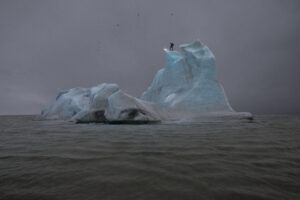
Julian Charrière, ‘The Blue Fossil Entropic Stories III’, 2013. Copyright the artist; VG Bild-Kunst, Bonn, Germany
By engaging with the ice not as symbol, but as matter imbued with memory, the work asked how a single gesture – however absurd – might render perceptible the entanglement of human presence with deep time, ecological fragility, and planetary systems. It was less an act of destruction than a form of harmonisation: a way to embody the contradictions of our condition.
Now, over a decade later, the climate emergency has only intensified. The image of the iceberg has become a visual cliché in climate discourse, and yet the absurdity of that early gesture still resonates. It marked an entry point – for me – into the strange theatre of climate politics and the poetics of loss, where artistic practice becomes a means of sensing what often remains invisible.
JKP: Pacific Fiction – Study for Monument reflects on histories of nuclear testing in the Pacific, where the ocean becomes a site of trauma and buried memory. What drew you to that context, and how do you approach the ocean as a political and memorial landscape?
JC: The Pacific, vast as it is, holds a dense accumulation of invisible violence. During my research, I was struck by how this seemingly pristine expanse had been deeply inscribed by Cold War geopolitics – especially through nuclear testing. The Marshall Islands, and Bikini Atoll in particular, became dystopian sites par excellence. Between 1946 and 1958, the United States detonated nearly seventy nuclear bombs there, including Castle Bravo – the single most powerful H-bomb ever tested by the U.S. – which obliterated entire islands from the map. These sites have been both irradiated and erased, turned into unacknowledged monuments of technological ambition, colonial trauma, and ecological devastation.
Pacific Fiction emerged from my time in the Marshall Islands and is part of a larger effort to trace the afterlives of these landscapes. The sculpture, a pyramid of coconuts encased in lead, functions as a kind of speculative memorial. The coconuts reference the etymology of “Bikini,” which comes from the Melanesian Pikinni – with pik meaning “surface” and ni meaning “coconut palm.” Their arrangement evokes a pile of cannonballs, but also tomb offerings, or perhaps even dormant seeds. The lead casing is not only sculptural, but functional – it symbolizes the legacy of radiation, a protective skin against invisible contamination.
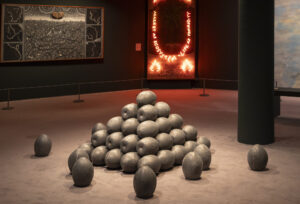
Julian Charrière, Pacific Fiction – Study for Monument (found Bikinian coconuts in lead sarcophagi, steel-frame), Installation view: A World of Water at the Sainsbury Centre
With Pacific Fiction, I wanted to challenge the idea of the ocean as passive or inert. It’s not just a medium – it’s a witness that carries memory in its currents, its sediments, its silences. I approached it as a liquified archive, one that refuses to remain buried. My interest wasn’t only in the historical events themselves, but in their resonance – how they reverberate into the present, entangled with ecological vulnerability and cultural erasure. The work’s pyramid shape and subtitle, Study for Monument, recall both ancient tombs and the angular monoliths of military architecture – suggesting that memory, like matter, can be submerged but not destroyed.
JKP: Our season is framed by the question Can the Seas Survive Us? How does this question resonate with you? And how might your work offer a different way of thinking about survival, resilience, or responsibility?
JC: The question Can the Seas Survive Us? is powerful because it flips the usual script. It shifts the focus from a human-centred narrative to something more humbling – and more accurate. The ocean has endured extinction events, tectonic upheavals, and planetary reconfigurations. Another way to approach this might be to ask: can we survive what we’ve set in motion within the sea?
That kind of inversion aligns closely with my practice. Much of my work revolves around disrupting inherited perspectives – inviting shifts that reveal our entanglement with systems we often treat as distant or abstract. I’m not trying to represent ecological crisis in a didactic way, but to create encounters that make that entanglement perceptible – bodily, emotionally, temporally.
To me, responsibility begins with perception – not with guilt, but with attention. If we stop imagining the ocean as something separate, and instead recognize that we’re suspended within it – historically, chemically, metabolically – then the question of survival becomes less about saving something ‘out there’ and more about reconfiguring how we relate to what sustains us.
JKP: Lastly, what questions are you carrying with you into your next chapter? Will the oceans and the seas remain a focus in your work, or are you being drawn to new elements, new terrains, or new uncertainties?
JC: The ocean will continue to be a gravitational force in my work – it’s too vast, too complex, too entangled with everything else to be exhausted. But I’m increasingly drawn to the ways aquatic and terrestrial systems overlap, bleed into one another, and shape shared ecologies. I think the binary between land and sea is collapsing, both physically and conceptually, and that space of entanglement is where I see my next questions forming.
The exhibitions in Basel and Wolfsburg, along with the publication that accompanies them, feel less like a conclusion and more like an opening – one I’ll continue to explore, at least through my upcoming project at MOCA in 2026. A core question remains: how to feel the deep – not just how to understand it intellectually, but how to develop a cultural and emotional literacy for that space.
The ocean has long been treated as a backdrop, a service provider, or a dumping ground – something instrumental rather than essential. But it’s not peripheral. It’s the planet’s circulatory system, its first skin. And as we enter a period of intensifying planetary instability, I believe the sea is where some of our most urgent, unresolved questions reside. That’s where my attention is anchored – for now.
You can catch Midnight Zone, Pacific Fiction – Study for Monument, and The Blue Fossil Entropic Stories in A World of Water at the Sainsbury Centre, until 3 August.