Channel Feature
Denzil Forrester on his drawing The Rose, social injustice, and creating work from your heart
March 2026
CONTENT WARNING – this article contains discussions of police brutality, which some readers may find distressing.
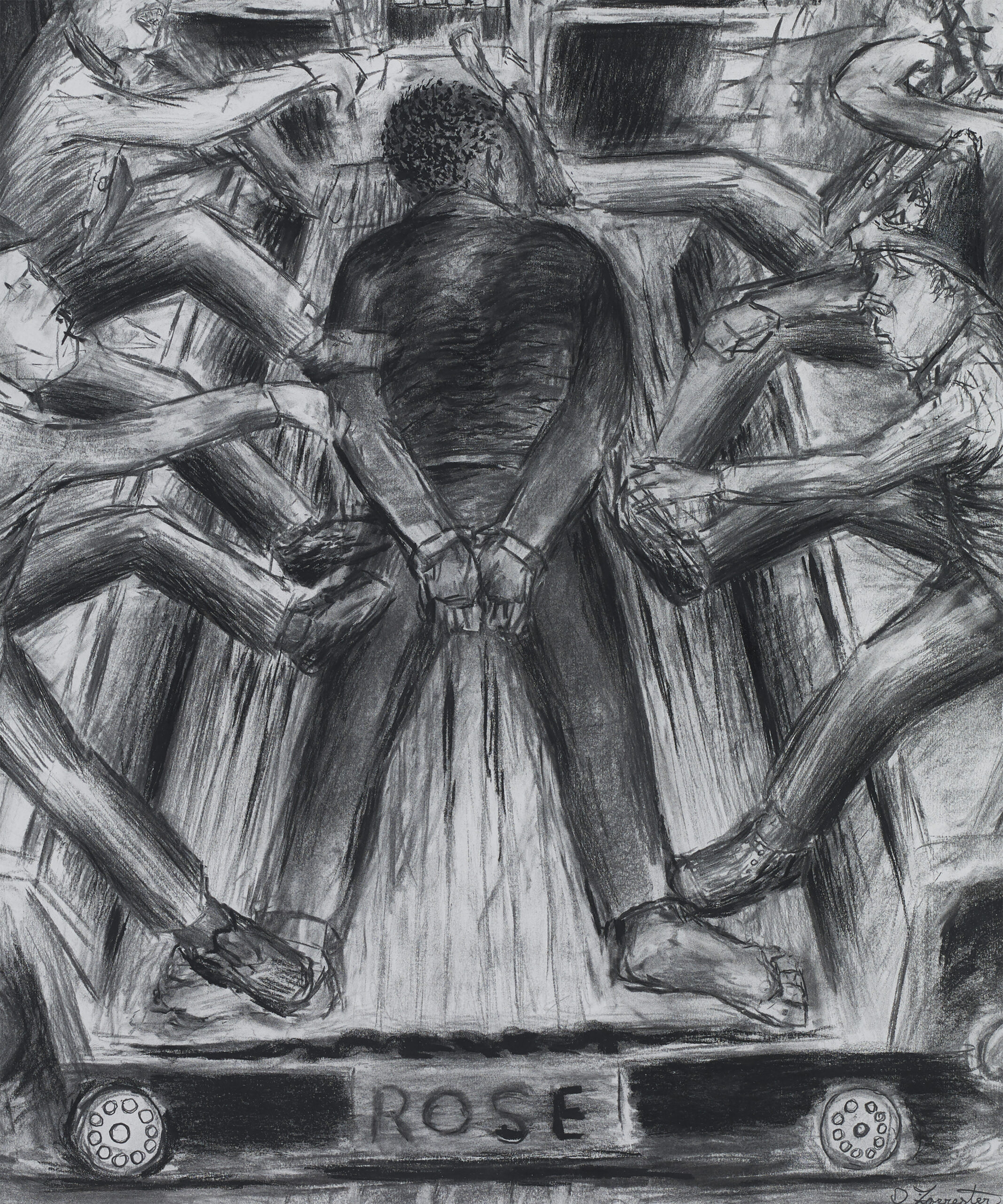
Denzil Forrester, The Rose
Denzil Forrester’s work saw him frequenting East London nightclubs for four decades of his practice, capturing the energy, heart and soul of the reggae and dub club scene. He worked quickly and vividly whilst watching and dancing, speaking of how “it is actually in your body” as he made the work.
Then one evening in July 1981, the six o’clock news reported on the death of Forrester’s childhood friend and neighbour, Winston Rose, who had died in police custody. A series of works depicting social injustice began.
Born in Grenada in 1956, Denzil Forrester MBE moved to London in 1967. Starting at the Royal College in 1981, Forrester attended the hearing for Winston Rose’s death, proceeding to document what had happened for his Royal College thesis, and later in a series of paintings and works on paper.
Forrester’s series of paintings and drawings about Winston Rose explores the racial injustice and societal tensions affecting Black communities at the time. They demonstrate the ongoing personal and political impacts of such injustices.
We spoke to Forrester at his home in Cornwall as his work The Rose (2014) hangs in the Sainsbury Centre’s current exhibition, Seeds of Hate and Hope.
Would you be okay to recall how Winston Rose died in police custody in July 1981, which is depicted in The Rose?
I found out where his family lived and reached out to them. At the Royal College you have to do a thesis, and at that time you had a free choice, you could write anything. I thought, why don’t I do it on Winston Rose? I decided to go to the hearing to get all the details of how he died – and tell the truth. In writing the thesis, I realised how horrible his death was.
He had mental illness, which would mean his wife would phone up for psychiatric help from nurses. This happened quite a lot but, this time, when a social worker called up for help, they did not get an ambulance, but the police came.
When Winston saw the police coming, he went and hid in his house and then in a shed in his garden out of shock and fear. The police entered the garden around the side, some with riot shields. He tried to run away but eight officers caught him, and a struggle happened. He was carried to the van on his back, unconscious, handcuffed, and put in the van to get him to hospital. The doctor at the hospital said that he choked on his vomit.
You can read Denzil Forrester’s full thesis, here.
Your practice has long been rooted in documenting Black British life, community, and resilience. How do you think art has the power to communicate and what agency does art have to make change?
If you are an artist you have to respond to what is going on around you. Artists are there to tell it how it is and show what is happening at the time. If the artist isn’t going to do it, no one else is. You cannot educate people to do art, it has to come from your heart and soul. A lot of people learn to paint and draw but many don’t know what they want to make art about.
What role do you believe artists have in informing reflections around violence and injustice?
Artists have to be expressive and show it. Because there is so much tech now, the physical aspect of feeling this within our hearts and souls is difficult because the tools we have, like phones, are so quick now, so that experience is very different and it is not documented so deeply. However, we are not going to lose that rawness in ourselves.
If viewers take away one message from The Rose within this exhibition, what would you want it to be?
Peace and love, because what is happening now in the world is pretty bad. Hope, because there are a lot of people out there doing good things, but they are not given higher ground.
The Sainsbury Centre’s season asks a blunt question: Can we stop killing each other? How does your painting contribute to that conversation?
My paintings are all about life really, the human form, the human movement, salvation, freedom… When people see the work, that’s what it is to do with – what they get from the work, the feeling that comes from it.
We need to live with the planet, all this stuff we keep doing to it, we are not listening to ourselves.
Our thanks go to Denzil Forrester for this interview.
Find out more about Seeds of Hate and Hopehere.
Seeds of Hate and Hope is part of our season Can We Stop Killing Each Other? It is curated by Tafadzwa Makwabarara, Curator of Cultural Empowerment at the Sainsbury Centre and Jelena Sofronijevic, independent curator, writer and producer of the EMPIRE LINES podcast.
The Can We Stop Killing Each Other? season has been developed in consultation with partners to provide a sensitive presentation of artworks to foster empathy and understanding through compassionate dialogue.