Channel Feature
A reading list inspired by the Sainsbury Centre collection
April 2026
National Centre for Writing’s book picks, inspired by selected works in our permanent collection.
National Centre for Writing's book picks, inspired by selected works in our permanent collection.
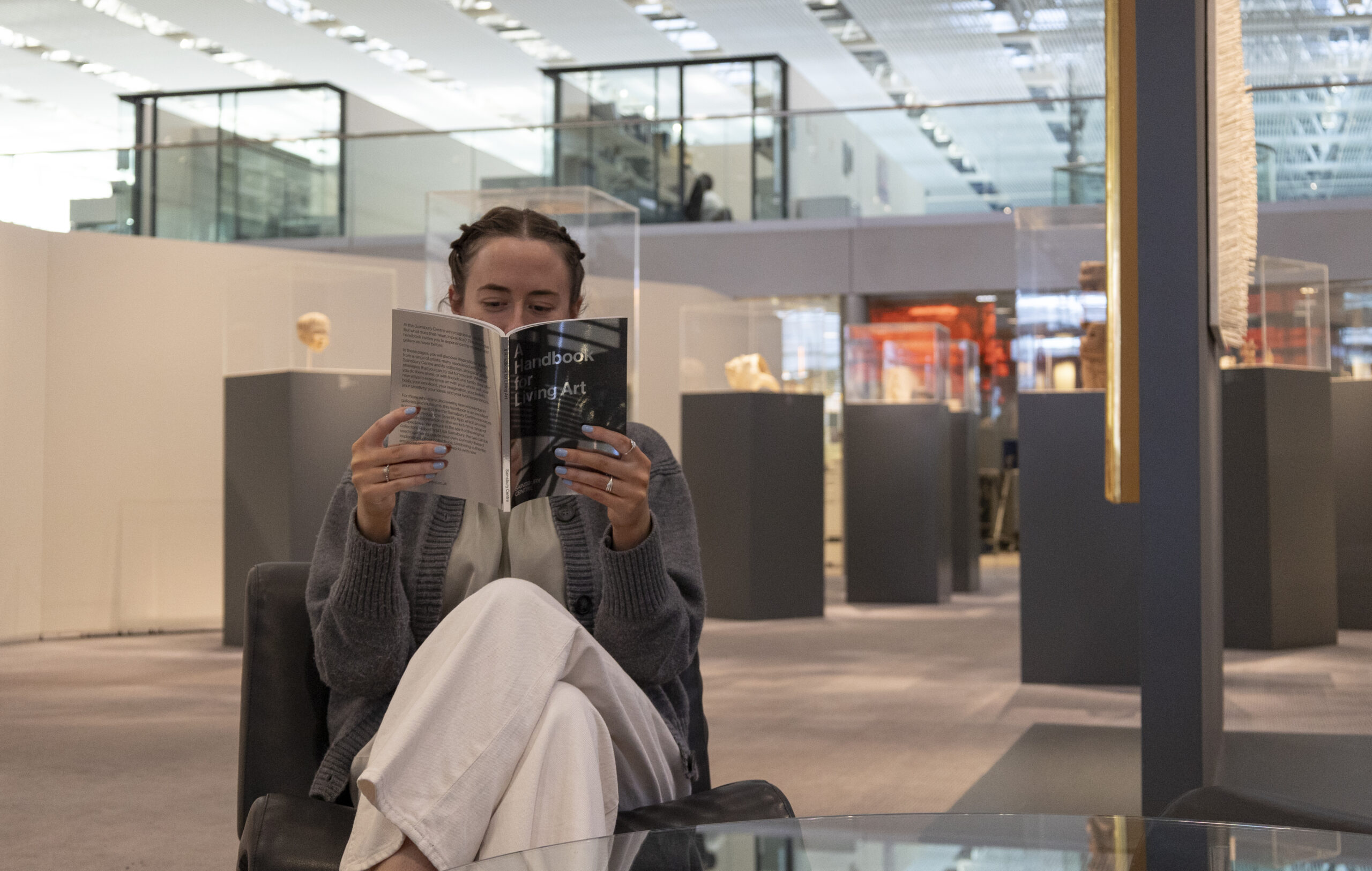
Art and books both tell stories, just in different languages: one through visuals, the other through words. Taking pieces from the Sainsbury Centre’s permanent collection, our friends at the National Centre for Writing have drawn up a reading list of books which pair and compliment eight works of art from across the globe, drawing out connections and shared themes between visual and written storytelling.
By National Centre for Writing
Male Figure (‘Fishermen’s god’)
Ruby, duty manager at the National Centre for Writing, paired this piece with The Wayfinder by Adam Johnson as both bring the spiritual to life, one through story, the other through sculpture.
The carved figure guided canoes and invited the divine into wood; Johnson’s novel guides readers across myth and ocean, letting ancestors and stars speak. Both turn journeying, whether across sea or story, into a sacred act, and both survive the marks of colonial disruption while keeping their power.
In different ways, they show how Polynesian culture sees art, faith, and navigation as inseparable, and how creation itself is a way of connecting with the world.

Female Nude with Arms Raised by Pablo Picasso
This drawing reminds Katie, learning and participation producer at the National Centre for Writing, of Picasso’s drawing of Gertude Stein, and of Stein more generally. She says:
‘I have been reading Gertrude Stein: An Afterlife by Francesca Wade and I like the way that Wade tries to approach Stein as a woman of two halves – of a life and then its legacy. Picasso was notoriously not so sensitive and feminist in his artistic appraisals of his female sitters or even his lovers, and there was a close over between the two. I think that the book provides a nice contrast to thinking of modernism and cubism as a queer feminist endeavour, as well as something that is so associated with male genius.’
White Figure with Blue Miko by Leiko Ikemura
Leiko Ikemura’s headless female body of White Figure with Blue Miko is described as being ‘left open to the viewer to interpret’: the form, along with the artist’s half-Japanese heritage, brought to Holly, head of programmes at the National Centre for Writing’s, mind Diary of a Void by Emi Yagi.
Both the novel and sculpture seem to explore the idea of invisibility; a void that doesn’t necessarily signify something is missing but that it’s hasn’t been seen to begin with. Yagi’s story is about a single Japanese woman who falsifies a pregnancy as an act of subversion in the workplace, to gain the benefits and respect afforded to pregnant women; her rights and needs are not visible without her bump. Ironically, she ends up lonelier and more isolated, in her attempt to try and ‘fit in’ with society’s expectations of young women.
The missing head – the void – in Ikemura’s sculpture could also have a feminist inference; perhaps by leaving out the head Ikemura is commenting on the mental load women often carry that goes unrecognised. Perhaps in looking at what’s not there, we finally see its essential nature. Or perhaps, as in Diary of A Void, it’s about the disconnect between how society chooses to value women’s bodies. As with good fiction, the more Holly looks at the sculpture, the more interpretations can be found.
Hunting snow goggles or maskette
These snow goggles remind Steph, senior communications and marketing manager at the National Centre for Writing, of the treacherous and largely unexplored cold regions of our world; landscapes that serve as compelling backdrops for several novels she’s particularly enjoyed.
The first is The North Water by Ian McGuire, a historical fiction-crime thriller set in 1859 aboard a whaling ship bound for the Arctic Circle. Dark, gritty, and brutally violent, the novel features one of the most loathsome characters ever to grace the page: Henry Drax! It has also been adapted for television, starring Jack O’Connell and Colin Farrell.
The second is Burial Rites by Hannah Kent. Set against the stark, unforgiving landscape of 1829 Ireland, Kent tells the haunting story of Agnes, a woman condemned to death for her role in the murder of her lover.

Head of a Woman (Anna Zborowska) by Amedeo Modigliani
Annie, ILX programme manager at the National Centre for Writing, paired this piece with People in the Room by Norah Lange.
Norah Lange was a modernist Argentinian writer, associated with the Buenos Aires avant garde movement of the 1920s and 1930s, and so we can see the same influences in her work as in Head of a Woman. Her 1950 novel, People in the Room (recently translated into English by Charlotte Whittle), follows a woman who spies three women in the house across the street, imagining them as criminals, as troubled spinsters, or as players in an affair. Like Zborowska’s head, none of the women can be truly known, and the novel becomes an exploration of desire, domestic space and female isolation.
Hybrid Mask (Baule/Yaure)
This hybrid mask, with its Picasso influences and a sharp Spanish feeling woven in with its African roots, made Katie, learning and participation producer at the National Centre for Writing, think of the novel I Gave You Eyes and You Looked Toward Darkness by Irene Sola.
The novel, a work of folk horror, draws on the magical realist traditions of postcolonial literature from Africa and Central America but with a particularly Catalan flavour. It tells the story of generations of Catalan women using or trying to use the power of magic and folklore to control the patriarchal forces and those of Castile Spain that silence and oppress them.
Cache-pot by Lucie Rie
The beauty of Lucie Rie’s Cache-pot holds a light to The Anthropologists by Aysegül Savas, suggested by Rebecca, emerging translator mentorships programme manager at the National Centre for Writing.
Both Rie’s approach to pottery and Savas’ work seem to be concerned with the beauty in the everyday, the small miracles in household objects all around us, particularly in urbanized lives. Savas is concerned with modern relationships, of people not originally rooted to a place but who have made a city their home — not too different from Austrian emigree Rie, who settled in Britain in the 30s.

Stack (body set in motion) by Ro Robertson
Both exploring what it means to live with change at the end of the land, this piece reminds Ruby, duty manager at the National Centre for Writing, of The Easternmost House by Juliet Blaxland.
Blaxland writes about watching her Suffolk home slowly fall into the sea, turning that loss into a tender reflection on nature, time, and belonging. Robertson’s artwork, shaped by the Cornish coastline, captures a similar push and pull between strength and softness: stone and water, body and landscape. While Blaxland records the coastline’s slow collapse, Robertson celebrates its constant motion, and both remind us that nothing: land, body, or identity, stays still for long.
All pairings:
- Male Figure (‘Fishermen’s god’) The Wayfinder by Adam Johnson
- Female Nude with Arms Raised by Pablo Picasso Gertrude Stein: An Afterlife by Francesca Wade
- White Figure with Blue Miko by Leiko Ikemura Diary of a Void by Emi Yagi
- Hunting snow goggles or maskette The North Water by Ian McGuire / Burial Rites by Hannah Kent
- Head of a Woman (Anna Zborowska) by Amedeo Modigliani People in the Room by Norah Lange
- Hybrid Mask (Baule/Yaure) I Gave You Eyes and You Looked Toward Darkness by Irene Sola
- Cache-pot by Lucie Rie The Anthropologists by Aysegül Savas
- Stack (body set in motion) by Ro Robertson The Easternmost House by Juliet Blaxland
Our special thanks go to National Centre of Writing. National Centre for Writing is a contemporary literature house in the heart of England’s first UNESCO City of Literature, committed to the transformative power of stories for personal, social and community development. Rooted in Norwich and open to the world, the National Centre for Writing is a writing development agency with a local, national and international footprint.