Channel Feature
‘I remember washing my hands obsessively’: Gideon Rubin on redacting Mein Kampf
March 2026
“Artists should position themselves slightly to the side and look where others don’t.”
"Artists should position themselves slightly to the side and look where others don’t."
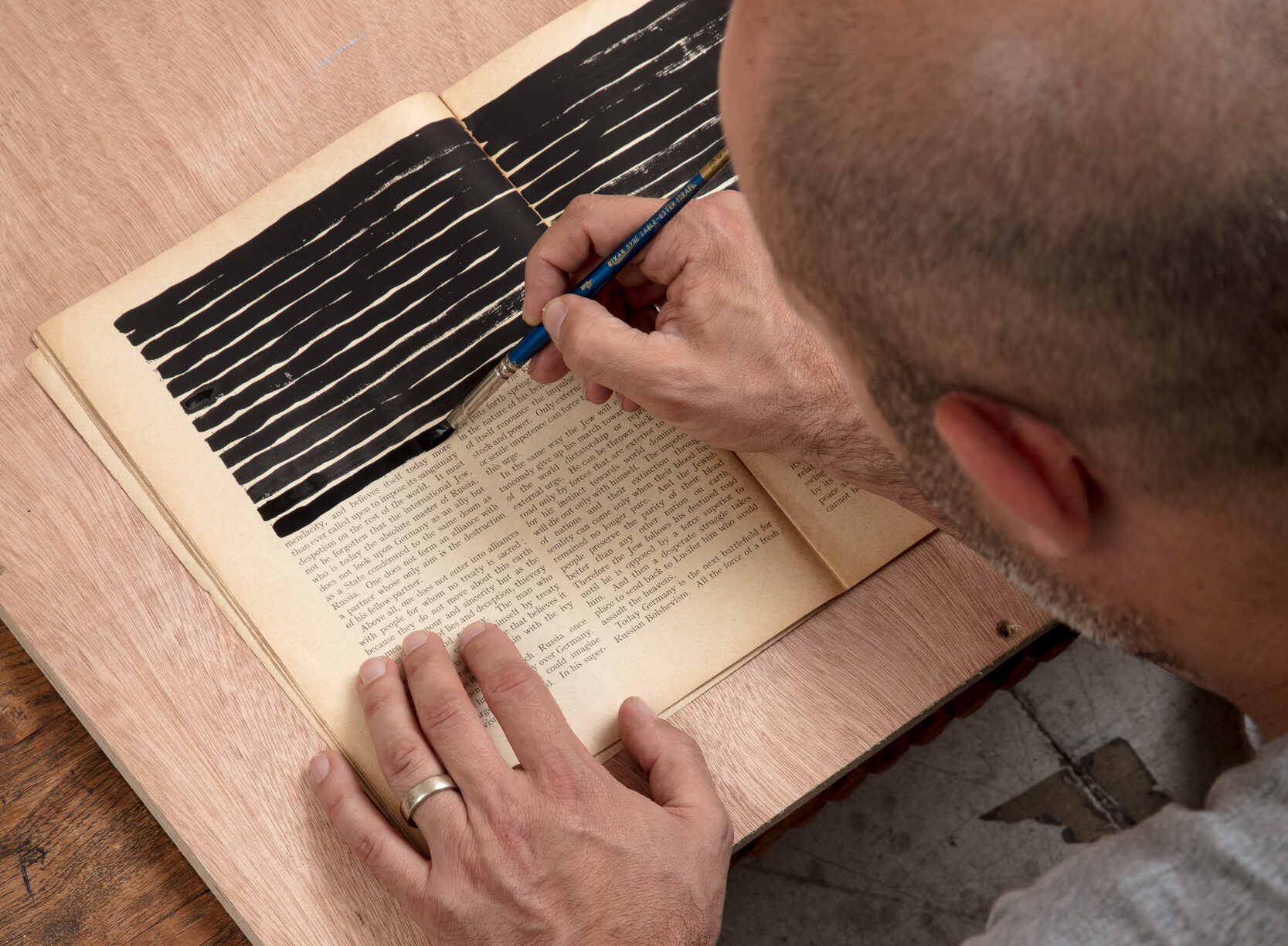
In 1939, Adolf Hitler’s infamous autobiography Mein Kampf, meaning ‘My Struggle’, was translated into English and published in London. Gideon Rubin turns the book into abstract art by blacking out every page. Through this act of erasure, Rubin symbolically strips the text and Nazi imagery of their power, turning propaganda into silence. Black Book sits within Seeds of Hate and Hope, an exhibition at the Sainsbury Centre exploring the question: Can We Stop Killing Each Other?
Kate Wolstenholme: What first compelled you to create Black Book, and how did the project begin for you emotionally and artistically?
Gideon Rubin: The Black Book was created while I was working on my exhibition at the Freud Museum in London in 2018. At the time, I was painting over pre–Second World War newspapers and magazines, and my partner, the artist Silia Ka Tung, had inadvertently bought me a serialised English translation of Mein Kampf from the 1930s.
My first instinct was to throw it away or burn it, but instead, I began covering it in black gouache – page by page, paragraph by paragraph, word by word. I didn’t feel then, nor do I now, that I initiated this act. It was as though the erasure happened through me, against my own will.
I remember washing my hands obsessively each time my fingertips touched the paper, as if evil could somehow jump from the page. Yet, by the time I reached the end; covering the final pages in black, I didn’t want it to end.
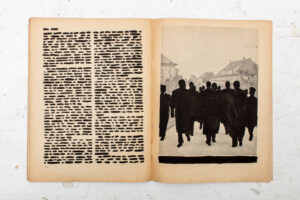
Gideon Rubin, ‘Black Book’, Adolf Hitler covered over, gouache on printed paper (p.16), 2017. Courtesy of the artist
KW: You’ve spoken about how memories change, in comparison to covering up and erasing texts and imagery in your work. Could you expand on this?
GR: Memory is an organic, living entity. We often treat it as fact, yet it’s constantly reshaped by circumstances. In many ways, memory is not about the event itself but about the layers that accumulate on top of it.
Erasing or covering an image in paint becomes a kind of new mark, holding within it the traces of everything that came before. Using Freud as a premise, I wanted to reverse his process, if he sought to uncover the unconscious, I wondered if by covering the text, I might reach something equally essential hidden beneath. Would the redacted text reveal anything at all?
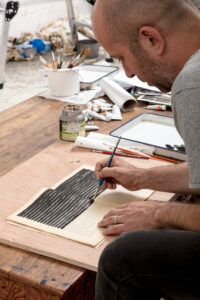
Gideon Rubin painting ‘Black Book’
KW: Black Book sees you remove and redact information, taking away voice and power from a historic document. What role do you believe artists have in prompting reflection around violence and injustice?
GR: Artists should position themselves slightly to the side and look where others don’t. For me, art is creation, which by definition opposes destruction. Life stands opposite death. Art can never condone or support violence.
I often think about ‘White Rose’, the non-violent student resistance group in Nazi Germany. A handful of young people in Berlin printing and distributing little slips of paper, calling for active opposition to the regime – such a small, almost silent action, yet one that radiates immense human defiance. That’s the power of art.
Different artists approach war and violence in their different ways, but I don’t believe political art is necessarily more effective in taking a stand. The very act of making art is a form of resistance, it’s choosing creation over destruction, life over death.
I recall reading a letter by Giorgio Morandi, shown in an exhibition at the Estorick Collection. In it, he complains about the noise of fighter planes disturbing him at work. At first, I found this shocking — to be distracted from painting by noise while Europe was burning. But then I understood: art can transform pain into healing, acting as a spiritual antidote, a way to mend the human soul.
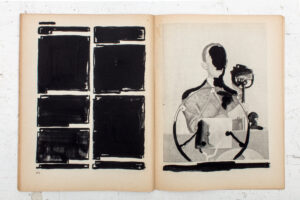
Gideon Rubin, Black Book, Joseph Goebbels giving a speech, gouache on printed paper, (p.484), 2017. Courtesy of the artist
KW: The exhibition title Seeds of Hate and Hope suggests both the origins of violence and the possibility of transformation. How does Black Book sit within that tension?
GR: Creation and destruction, life and death – these are opposites, yet they coexist, moving through the same universe. Art, like life, is built in layers: strata of memories and experiences, birth and decay, ending and beginning again and again in an endless cycle.
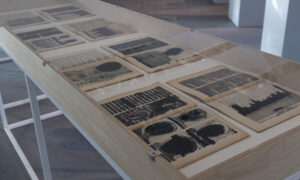
Installation view of ‘Black Book’ in Seeds of Hate and Hope. Photo: Kate Wolstenholme
KW: What was the significance of redacting an English translated version of Mein Kampf?
GR: For me, the significance was personal. Art allowed me to face something I otherwise couldn’t. I recall asking myself: *Does evil have a rhythm? Would covering it reveal anything? I doubted it, yet I hoped that viewers might find something in this simple, repetitive, painterly act.
KW: How do you protect your emotional wellbeing when working with themes of violence and trauma?
GR: While making the work, I had to limit myself to just an hour or two each day. I would paint a spread, leave it to dry, and return the next day. I tried to keep my aesthetic decisions minimal – I simply needed to cover every letter, every word and sentence.
I used two types of black (one glossy, one matte) and followed that instinctively, as though the act itself should guide the outcome rather than any formal plan.
KW: If viewers take away one message from Black Book within this exhibition, what would you want it to be?
GR: If it makes people pause and think, that’s enough for me. I remember worrying about Holocaust survivors seeing the work at the Freud Museum, fearing they might think I had treated the subject lightly or turned it into spectacle. To my relief, the opposite happened.
Find out more about Seeds of Hate and Hope here.
Seeds of Hate and Hope is curated by Tafadzwa Makwabarara, Curator of Cultural Empowerment at the Sainsbury Centre and Jelena Sofronijevic, independent curator, writer and producer of the EMPIRE LINES podcast.
Our thanks go to Gideon Rubin for this interview.